If you are searching for a virtual pinball machine kit, note that the products below are physical, mechanical pinball games or buildable models—not digital virtual pinball systems. The Smartivity Pinball Machine is best for a build-and-play STEM project, while the JTBBOY set adds lights and music. The UGEARS kit suits Harry Potter fans, and Smartivity Mini is a portable option for children. Alice Goes to Wonderland is a home cabinet, not a building kit.
| Product | Best For | Type |
|---|---|---|
| JTBBOY Pinball Building Set | Teens and adults wanting lights and sound | Motorized tabletop building set |
| Smartivity DIY Pinball Machine | Hands-on mechanical learning | Buildable, playable game |
| Smartivity Mini Pinball | Portable play for children | Handheld wooden kit |
| UGEARS Harry Potter Quidditch Pinball | Fans of themed wooden models | Buildable mechanical game |
| Alice Goes to Wonderland Pinball | Buyers seeking a home cabinet | Ready-made pinball machine |
JTBBOY Pinball Machine Building Set

Best for: Teens age 14 and older, adults, and families who want a tabletop build with arcade-style lighting and sound. This set is selected for combining construction with interactive play rather than serving only as a display model.
Its listed features include an M motor, LED light box, music box, marbles, a launcher, and flippers. The coin-operated play elements are noted as not included, and the description says the game has no scoring function. It is therefore better for casual play and building together than for score-based competition. The listing also notes that batteries are not included.
Smartivity DIY Pinball Machine

Best for: Buyers who want a hands-on mechanical project that remains playable after assembly. Smartivity describes this kit for ages 8 to 99, making it suitable for a child building with an adult, a teen, or an adult seeking a screen-free activity.
The game uses a spring launcher, flippers, and scoring targets. Assembly demonstrates concepts such as momentum, energy transfer, and mechanical advantage through levers, springs, and ramps. Choose this if physical construction and score-focused play matter more than electronic effects. The listed features do not mention lights, sound, or digital gameplay, so avoid it if you specifically want a virtual pinball setup.
Smartivity Mini Pinball Machine
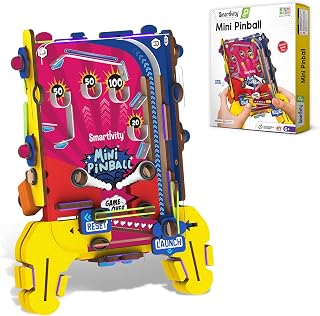
Best for: Children ages 6 to 12 who want a portable build-and-play game. Its handheld format is the main distinction: the listing says no table, electricity, or batteries are needed, and that it fits in a backpack.
The kit uses wooden parts and mechanical action, with a launcher, obstacles, and a ball. Children can play solo to improve a score or pass the game to someone else for a head-to-head challenge. It is better for portability than a tabletop arcade-style build. Its compact size is also a limitation for buyers who want a larger cabinet or a more substantial game surface.
UGEARS Harry Potter Quidditch Pinball

Best for: Harry Potter fans and builders who want a themed wooden game with a mechanical scoring system. This option stands out for its Quidditch field, character figures, house details, and interactive scoring—not for virtual or electronic play.
Listed features include flippers, bumpers, targets, obstacles, and a mechanical scoreboard. The game awards points for sending Quaffles through rings and describes capturing the Golden Snitch as an instant victory. Eight viewing platforms display house logos. Because this is a buildable wooden model, choose it for themed construction and physical gameplay; avoid it if you want a ready-to-play digital machine or an unthemed kit.
Alice Goes to Wonderland Pinball

Best for: Buyers looking for a home pinball cabinet rather than a DIY kit. It is included as a relevant alternative for shoppers whose main goal is arcade-style pinball at home, even though the listing describes a cabinet rather than a buildable kit.
Features include mechanical flippers, bumpers, spinners, LED lighting, and multiball modes, with a Wonderland theme and challenges inspired by familiar story characters. The compact home-cabinet design is described as suitable for living rooms and game spaces. Its limitation for kit shoppers is that the supplied information does not describe a build-it-yourself project or virtual pinball software.
Buying Guide: Choosing A Pinball Kit Or Virtual Setup
Do you want digital pinball or a physical game?
Start by distinguishing the two. Virtual pinball generally refers to a digital game played on a screen, while the products in this comparison use physical balls and mechanical components. None of the supplied product descriptions identifies a digital screen-based pinball kit or virtual pinball software. If digital play is essential, verify that a product specifically includes the software, display, controls, and hardware you need before buying.
Which features matter most?
- For lights and sound: The JTBBOY set lists an LED light box and music box, but no scoring function.
- For mechanical learning: Smartivity’s full-size DIY kit emphasizes springs, levers, ramps, and scoring targets.
- For portability: Smartivity Mini is described as handheld and battery-free.
- For themed play: UGEARS offers a Quidditch design and mechanical scoreboard.
- For a cabinet experience: Alice Goes to Wonderland is a home cabinet, not a kit.
Who will assemble and play it?
Check each product’s stated age range and consider whether the intended builder wants a simple portable activity or a more involved model. The listings identify Smartivity Mini for ages 6 to 12, Smartivity DIY for ages 8 to 99, and JTBBOY for ages 14 and older. The supplied UGEARS and Alice descriptions do not state an age range, so confirm the listing details if age suitability is important.
Frequently Asked Questions
Are these products virtual pinball machine kits?
No. The listed products are physical, mechanical games or models. The supplied descriptions do not identify a digital virtual pinball kit.
Which option includes scoring?
Smartivity DIY lists scoring targets, and UGEARS lists a mechanical scoreboard. JTBBOY specifically states that it has no scoring function.
Which kit is most portable?
Smartivity Mini is described as a handheld, pocket-sized game that fits in a backpack and does not need a table, electricity, or batteries.
Which product is not a building kit?
Alice Goes to Wonderland is described as a compact home pinball cabinet. The provided features do not describe it as a DIY kit.
Do any listed products require batteries?
The Smartivity Mini listing says it needs no batteries. The JTBBOY listing says batteries are not included, so check its requirements before purchase.