The best type of toy block depends on how a child likes to build: wooden blocks suit stacking and open-ended pretend play, bristle blocks connect at different angles, and large plastic sets offer many pieces for bigger constructions. The five options below include traditional blocks, flexible STEM building toys, an alphabet-based alternative, and a high-piece-count set. Check the listed age guidance and the kind of building each product supports before choosing.
| Product | Block Type | Best For |
|---|---|---|
| Melissa & Doug 100 Wooden Building Blocks | Wooden shapes | Classic stacking and early shape learning |
| PicassoTiles 120 Piece Hedgehog Blocks | Flexible bristle blocks | Angle-based, open-ended constructions |
| Contixo 144 pcs Bristle Shape Set | Bristle blocks | Hands-on building for ages 3–8 |
| Kannove 26 Alphabet Robots | Transforming letter pieces | Letter recognition with a building element |
| Tigerhu 1120pcs Building Blocks | Plastic building pieces | Large sets and shared construction play |
Melissa & Doug Wooden Building Blocks

Best for: Children who enjoy classic stacking, balancing, and imaginative construction. This set includes 100 solid wood blocks in four colors and nine traditional shapes, giving children varied pieces for towers, bridges, and other structures.
The set is also suited to simple learning activities. Children can count, sort, compare, and identify shapes while practicing fine motor skills and hand-eye coordination. Its sturdy cardboard storage box has a carrying handle for putting pieces away or moving the set.
Why it stands out: The range of familiar shapes supports open-ended play without requiring children to follow a model. Consider: These are stacking blocks rather than pieces described as connecting or interlocking, so choose another type if a child wants builds that fasten together.
PicassoTiles Hedgehog Bristle Blocks
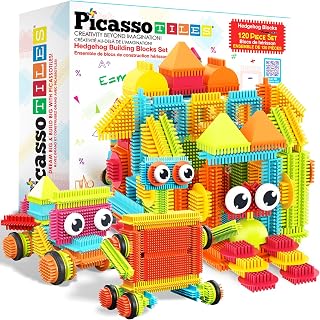
Best for: Children ages 3 and up who want building pieces that connect at different angles. The 120-piece set uses soft, flexible shapes with easy-connect tips. Children can create cars, houses, robots, and other three-dimensional designs, then take them apart and start again.
The maker describes the plastic as BPA-free, non-toxic, and lead-safe. With bright colors and flexible shapes, the set offers an open-ended way to explore basic construction ideas through repeated building and rebuilding.
Why it stands out: Its angle-based connections offer a different building experience from flat stacking blocks. Consider: The listed age is 3+, so this is not the pick for a child younger than the stated age range.
Contixo 144-Piece Bristle Building Set

Best for: Children ages 3–8 who want a larger bristle-block set for creative construction. The 144 soft-edge pieces are designed to connect easily, and the product description says the set is compatible with other sets to expand model options.
Building with the pieces can give children practice with fine motor skills, color recognition, and focus. The set is positioned for hands-on STEM and STEAM play, with flexible construction rather than a single required finished design.
Why it stands out: It combines a higher piece count than the 120-piece bristle option with stated compatibility for expanding builds. Consider: Adult supervision is recommended for children under 3 because of a choking hazard; the listed age range begins at 3.
Kannove 26 Alphabet Robot Set

Best for: Preschoolers who are interested in letters as well as construction-style play. This set includes 26 transformable pieces, one for each letter from A to Z. Each letter changes into a robot, and groups of letters can combine into three larger robots.
The product is designed to support letter recognition, hand-eye coordination, fine motor skills, spatial thinking, and engineering creativity. Its multiple play options include transforming individual letters and combining letter groups for a larger challenge.
Why it stands out: It adds an alphabet-learning purpose that conventional blocks do not provide. Consider: Choose it for letter-focused transformation play, not as a substitute for a set of traditional shapes or general-purpose building blocks.
Tigerhu 1120-Piece Building Blocks Set

Best for: Children ages 3 and up who want a large quantity of colorful plastic pieces for building alone or with others. The 1,120-piece set is described as supporting three-dimensional structures and imaginative designs. It includes a canvas storage bag for organization and cleanup.
The maker identifies the material as PP plastic and describes it as odorless. The large piece count makes this a suitable choice for families looking to support extended construction play and shared building activities.
Why it stands out: Its 1,120 pieces provide a notably larger building supply than the other sets in this selection. Consider: A high piece count can mean more pieces to sort and put away; choose a smaller set if simpler cleanup is a priority.
Buying Guide: How To Choose Among Types Of Toy Blocks
What kind of building does the child enjoy?
Choose wooden blocks for stacking, balancing, and creating structures from familiar shapes. Choose bristle blocks when the child wants pieces that connect at different angles. A large plastic set is a better fit when the goal is to have many pieces available for broad construction play. Alphabet robots suit children whose play interests include letters and transforming objects.
How many pieces are useful?
More pieces can give children a wider supply for larger or shared builds, but they can also take longer to sort and store. A 100-piece wooden set or 120-piece bristle set may be easier to manage than a 1,120-piece collection. Consider available storage space and whether children will play alone or together.
Which details should parents check?
Confirm the product’s stated age range and material details, and consider whether the pieces match the child’s coordination and interests. The Contixo listing recommends adult supervision for children under 3 because of choking hazards; PicassoTiles and Tigerhu list age guidance beginning at 3. Storage is another practical difference: the wooden blocks include a cardboard box, while Tigerhu includes a canvas bag.
Frequently Asked Questions
What are the main types of toy blocks?
Common types include wooden stacking blocks, connecting or interlocking pieces, flexible bristle blocks, and specialized blocks designed around letters or other learning themes.
Are wooden blocks or bristle blocks better for beginners?
Wooden blocks offer straightforward stacking and shape play. Bristle blocks connect at different angles, which suits children who want pieces that attach to form three-dimensional designs.
Which option is best for learning letters?
The Kannove set is the letter-focused choice in this selection. It includes transformable pieces for all 26 letters and activities involving individual letters and combined letter groups.
Which set has the most pieces?
The Tigerhu set has the highest stated count, with 1,120 pieces. Its product description also lists a canvas storage bag.
What should I check before buying blocks for a toddler?
Check the listed age guidance and any supervision or choking-hazard information. Select a set that matches the child’s age and abilities, and plan for safe storage between play sessions.