Looking for a stationary baby activity center that stays put while your child explores? These centers provide age-appropriate exploration without frequent repositioning, helping toddlers develop fine motor skills, balance, and early problem-solving. The best picks here are suited for babies who are ready to sit upright with some independence and for growing toddlers who benefit from a stable play surface. The top five selections emphasize multi-stage use, durable construction, and engaging toys to support developmental milestones.
| Product | Why It’s a Fit | Best For |
|---|---|---|
| Skip Hop Baby Activity Center: Interactive Play Center with 3-Stage Grow-with-Me Functionality, 4mo+, Explore & More | Multi-stage design with 360° seat and 25+ activities; grows from seat-based play to a toddler table | Babies who need a versatile, long-lasting activity center |
| Skip Hop Baby Activity Center: Interactive Play Center with 3-Stage Grow-with-Me Functionality, 4mo+, Silver Lining Cloud | Similar grow-with-me concept with a distinct theme and 25+ activities; includes a light-up piano | Babies who enjoy a bright, visually stimulating setup |
| Little Acorn, 4-in-1 Baby Activity Center | Montessori-Inspired Design | 8 Interactive Toys | Four play modes from tummy time to toddler table; 8 Montessori-inspired toys | Parents seeking a Montessori-style, long-lived center |
| 6-in-1 Baby Activity Center, Stationary Standing Activity Table (White) — Cochymi | Six modes in one center with a built-in storage basket and block board | Families needing compact, all-in-one evolving play space |
| Tiny Love 5-in-1 Here I Grow Stationary Activity Center – Black & White Décor | Five modes from tummy time to toddler table with music and movement elements | Parents wanting a sensory-rich, stroller-friendly aesthetic |
Skip Hop Explore & More Activity Center (4mo+) — Silver Lining Cloud
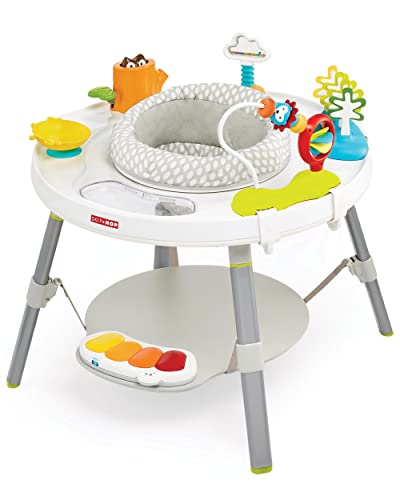
This activity center grows with your child in three stages, beginning with a seated play phase and evolving into a standing, interactive center and finally a toddler table. It features a 360° rotating seat, more than 25 developmental activities, toy loops for customization, and a discovery window with a musical light-up piano. Suitable for babies who can hold their head up unaided and up to 25 lbs. This option is best for families seeking a long-term play station that remains stationary while still offering dynamic play.
Who it’s best for: families wanting a single, durable center that transitions from infant to toddler use without needing a separate table. Why selected: it merges extensive activity options with a compact footprint and a pediatrician-informed design. Caution: requires 3 AAA batteries for the piano and light features, which may need replacement over time.
Skip Hop Explore & More Silver Lining Cloud Activity Center
This variant shares the same core grow-with-me design and a vivid, cloud-themed aesthetic. It offers a 360° seat and a wide array of activities designed to promote fine motor skills, coordination, and sensory exploration. The multi-mode setup makes it a strong choice for parents who want a single purchase that will evolve with their child, reducing the need for multiple separate toys or centers.
Best for: households that prefer a bright, themed center with substantial play options. Limitation: like other electronic features, the piano requires batteries for full functionality.
Little Acorn 4-in-1 Baby Activity Center
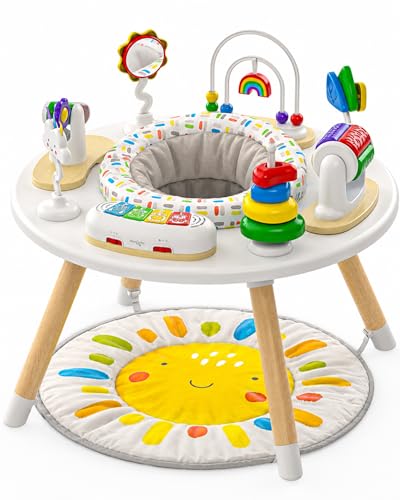
Designed to grow from tummy time into a toddler table, this Montessori-inspired center includes 8 interactive toys. It supports cognitive and motor development through a variety of sensory experiences, including an interactive learning piano with multiple phrases, sounds, and songs. Batteries are included for immediate use. This option is best for parents who prefer a carefully curated toy assortment aligned with Montessori principles and long-term use.
Best for: a Montessori-oriented, multi-stage activity hub. Caution: ensure the included batteries are maintained for continuous play.
6-in-1 Baby Activity Center, Cochymi (White)

This unit provides a 6-stage progression—from a rotating seat for early exploration to a standing play center and a dedicated toddler table. It also includes a built-in block board and storage basket, aimed at reducing clutter. Its design emphasizes Montessori-inspired sensory activities, fostering hand-eye coordination and spatial awareness. Best for families needing compact, all-in-one equipment that adapts to growing children. Limitation: some parents may prefer larger play spaces for active toddlers.
Time Followers 6-in-1 Baby Activity Center

This 6-in-1 center covers stages from a baby jumper to a study desk and game table, plus a portable building block board and storage basket. It is designed for ages 6-36 months and meets safety standards with a non-tip base. It emphasizes a broad range of sensory activities to engage babies in a stationary setup while providing longevity as a toddler table. Best for parents seeking a single investment that grows from infancy to early school years. Caution: the assembly and range of components may require careful setup to ensure stability.
Tiny Love Here I Grow Stationary Activity Center

With five modes spanning tummy time, activity stand, desk-style play, and a toddler table, this center emphasizes a black-and-white décor for visual stimulation and a variety of interactive toys designed to promote cognition, motor skills, and creativity. It is best for parents who want a visually modern center with a focus on early sensory experiences. Limitation: color-palette may be less stimulating for some infants who prefer a broader color range.
Buying Guide: Key Considerations for Stationary Baby Activity Centers
- Age range and growth trajectory: Look for centers that adapt from infancy to toddler years without needing separate purchases.
- Safety and stability: Choose models with a sturdy base and non-tip design. Check for BPA-free materials and certified safety standards as applicable.
- Number and type of activities: Consider centers offering a mix of fine motor, cognitive, and sensory play, including music, gears, and movable parts.
- Size and footprint: Ensure the center fits your available space and that the surface is truly stationary during use.
- Power and batteries: Some features require batteries; factor ongoing battery replacement into the total cost of ownership.
- Cleaning and maintenance: Removable toy components and washable seat pads simplify upkeep.
FAQ
- Q: What age is best for a stationary activity center? A: Typically best for babies who can sit upright without assistance and for toddlers up to around 2-3 years, depending on the model’s weight limit.
- Q: Do stationary centers rotate or move? A: Many offer a 360° rotating seat inside a fixed base; the seat rotates while the base stays in place.
- Q: Are these centers safe for carpeted floors? A: Yes, but ensure the base is wide and non-slip; use a play mat if needed for stability.
- Q: Do activity centers require batteries? A: Some include electronic features like a piano or lights that require batteries; check if they’re included or need replacement.
- Q: How do I choose between Montessori-inspired and traditional designs? A: Montessori-inspired centers emphasize self-directed exploration and defined wooden-like toys, while traditional designs focus on a larger variety of rotating toys and themes.
- Q: Is upgrading to a different center necessary as my child grows? A: If the center’s stages align with your child’s development, you can maximize use without an upgrade; otherwise, plan for a longer-lasting option with multiple stages.