Roller coaster building kits combine engineering challenges with creative play, helping learners explore physics, energy, motion, and problem solving. This guide highlights five engaging models that suit classrooms, makerspaces, and curious families. Each option emphasizes hands-on construction, step-by-step experimentation, and expandable challenges to grow with skills.
| Product | Brand | Key Focus | Ideal For |
|---|---|---|---|
| Thames & Kosmos Roller Coaster Engineering STEM Kit | Thames & Kosmos | Working roller coasters, physics experiments | Older kids and STEM classrooms |
| K’NEX Education – Roller Coaster Set | K’NEX | 546 pieces, motor, multiple models | Group projects, STEAM inquiries |
| ThinkFun Roller Coaster Challenge | ThinkFun | Logic, engineering, puzzle-driven builds | Critical thinking for kids 6+ |
| K’NEX 51438 Typhoon Frenzy | Basic Fun | 19 ft of track, two-build option | Hands-on construction and design exploration |
| CDX Blocks: Little Dipper | CDX Blocks | Gravity-powered coaster with gear system | Creative building with standard blocks |
Thames & Kosmos Roller Coaster Engineering

The Thames & Kosmos kit focuses on designing and building working roller coasters while conducting physics experiments. Learners explore forces, motion, energy, velocity, and related concepts through hands-on challenges. The kit emphasizes constructing coasters of varying shapes and sizes, encouraging iterative testing and refinement to optimize performance.
K’NEX Education Roller Coaster Set

This 546-piece K’NEX Education set includes a battery-powered motor and multiple models, enabling solo or small-group builds. An activity booklet guides learners through three experiments aligned with STEM standards, covering time, distance, speed, and more as students investigate cause-and-effect in motion and design choices. The set supports inquiry-based learning and collaborative problem-solving through hands-on construction.
ThinkFun Roller Coaster Challenge

ThinkFun’s Roller Coaster Challenge blends logic games with engineering tasks. With a game board, posts, tracks, a coaster car, and 40 challenge cards with solutions, this set helps players develop planning, reasoning, and spatial visualization while building a functioning miniature coaster. It’s a compact entry point that scales to more complex challenges as skills grow.
K’NEX 51438 Typhoon Frenzy
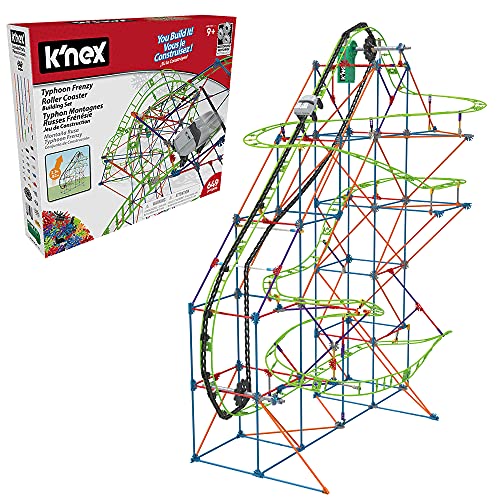
Typhoon Frenzy provides a sizable building experience with more than 640 pieces, including track, rods, connectors, and a motorized power system. The kit features two build options—one creating a long, twisting coaster and an alternate model, the Tsunami Surge Coaster. This dual-model approach encourages experimentation with different paths, speeds, and ride dynamics while strengthening fine motor skills and logical thinking.
CDX Blocks: Little Dipper

CDX Blocks Little Dipper combines gravity-powered roller coaster play with a gear system for realistic operation. This set uses a mix of custom and standard blocks, delivering quick assembly and authentic action. It’s ideal for kids expanding into more complex mechanical thinking, offering broad compatibility with other block systems to maximize play potential and creativity.
Buying Guide
- Educational goals: For hands-on physics, prefer kits that emphasize force, energy, motion, and measurement. If group work is a priority, look for sets with multiple models and an activity guide.
- Companion materials: Some sets include experiments or lesson guides aligned to STEM standards, which support structured learning and assessment.
- Motorized vs. gravity-based: Motorized coasters enable speed and acceleration studies, while gravity-only designs emphasize energy transfer and potential-to-kinetic energy conversion without power requirements.
- Age and skill level: Check piece counts and complexity to match the intended learner’s age and building proficiency. Some sets are ideal for younger builders, others suit older students or adults with advanced challenges.
- Expandability: If you plan to grow the project, choose kits with extra tracks, alternative models, or compatibility with standard blocks to integrate with other systems.
- Durability and materials: Wooden or high-quality plastic components typically offer sturdiness for repeated builds, especially in classrooms or libraries.
- Safety and maintenance: Look for non-toxic materials and clear safety guidelines. Durable parts reduce the need for frequent repairs during and after lessons.
- Assessment potential: Choose sets that include documentation for experiments and data collection to quantify outcomes such as speed, track length, and ride smoothness.
Across these options, learners build intuition about how design choices influence ride dynamics. Whether you’re pursuing classroom-ready experiments or family-friendly DIY challenges, these roller coaster kits provide structured paths to explore engineering, physics, and creative problem solving through play.