Choosing the right RC remote control and receiver is essential for reliable steering, throttle, and overall stability of your cars, boats, drones, or crawlers. The following selections emphasize range, interference resistance, gyro options, and model storage. Each entry includes practical features that help you compare performance across popular brands. This guide focuses on 5 kits that provide strong value for hobbyists and DIY builders alike, spanning 2.4 GHz systems with various channel counts and gyro capabilities.
| Product | Brand | Key Benefit | Link |
|---|---|---|---|
| DUMBORC X6 6 Channel | DUMBORC | Mixed channel control with gyro and multi-power charging modes | View |
| Radiolink RC4GS V3 | Radiolink | 30-model storage, built-in gyro, robust anti-interference | View |
| Radiolink RC6GS V3 | ATA HOBBY | 7-channel versatility, R7FG gyro with telemetry | View |
| Flysky FS-GT3B | Targethobby | 2.4Ghz with wide frequency hopping and 3-channel support | View |
| havcybin GA-4H-TX | havcybin | 4-channel transmitter/receiver set with wide compatibility | View |
DUMBORC X6 6 Channel Transmitter With Gyro

The DUMBORC X6 is a 6-channel RC system designed for versatility across RC cars, boats, crawlers, and tanks. It uses a 2.4 GHz frequency with a fast 3 ms receiver response, enabling stable control at distances around 400 to 500 meters. The transmitter includes three charging modes—dry batteries, USB power, and a lithium battery socket—enhancing field usability. A low-power alarm helps protect the battery and the model. Mixed mode functionality allows independent channel control configurations, making it suitable for DIY model projects. Gyro sensitivity can be adjusted to fine-tune stability.
Hobby Fans RC Radio System 4CH 2.4G

The Hobby Fans 4CH 2.4G system emphasizes anti-jamming and straightforward mixing control for two-channel operations. It uses FHSS (frequency hopping spread spectrum) to maintain a stable link at distances up to about 250 meters. The mixing control mode allows simultaneous throttle and steering management, which is helpful for RC cars and boats. This set is designed for ease of use and reliable control in typical hobby scenarios, though compatibility should always be verified with your receiver and model components.
Radiolink RC4GS V3 5 Channels

The RC4GS V3 by Radiolink stands out with a built-in gyro and robust anti-interference features. It supports extensive model storage (up to 30 models) and offers telemetry options and fail-safe settings. The transmitter pair is designed for RC crawlers and drifting, with CH3-CH5 configurable for VR or tact switch, enabling flexible control schemes. The 2.4 GHz link provides a balance of range and responsiveness, making it a strong choice for mixed-use RC hobbies.
Radiolink RC6GS V3 7 Channels
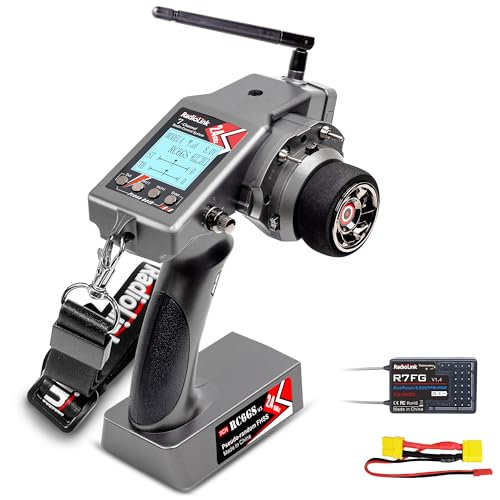
The RC6GS V3 kit is a high-channel setup, featuring 7 channels and a gyro-enabled receiver for enhanced stability. It provides real-time telemetry such as battery voltage and RSSI, and supports up to 30 stored models with customizable alarms. Advanced users can map CH5-CH7 to VR functions or FPV head-tracking, enabling sophisticated crawler or racing setups. The system’s anti-interference performance is reinforced by its ARM-based transmitter design.
havcybin 4CH RC Transmitter Set

The havcybin GA-4H-TX is a 4-channel transmitter/receiver set designed for RC cars, boats, tanks, and crawlers. It uses 2.4 GHz FHSS with 67-channel hopping to resist interference. The system emphasizes broad vehicle compatibility and a response time around 10-12 ms, with a typical control distance of 200-300 meters. This kit is well-suited for budget-conscious builders needing dependable baseline performance across multiple RC platforms.
Buying Guide: Key Purchase Considerations
- Channel count and mixing capabilities: More channels offer greater control options (throttle, steering, servo automation) and advanced features like VR or FPV head tracking. Decide how many channels you truly need for your model type.
- Gyro and telemetry: Gyro stabilization helps straight-line tracking and drifting, especially on cars. Telemetry informs you about battery voltage and signal strength, aiding maintenance and performance tuning.
- Interference resistance: FHSS and other hopping schemes reduce cross-talk in crowded radio environments. For shared spaces or competitions, high anti-jamming performance is valuable.
- Model storage and customization: More models stored means easier switching between vehicles. Look for programmable mix modes and user-configurable switches for personalized setups.
- Power options and portability: Battery compatibility (AAs, USB, or Li-po sockets) affects field use. Ensure the system’s power options align with your travel and field practices.
- Compatibility and expansion: Confirm that the transmitter is compatible with the receiver you intend to use, and check if the kit supports future upgrades or additional channels.
- Build quality and support: Reputable brands with clear documentation reduce setup time. Consider available firmware updates and customer support history when evaluating value.