The top picks below are organized for buyers seeking ready-to-fly aerial cameras. This guide helps beginners, hobbyists, and creators decide which drone fits their needs, whether indoors, outdoors, or on the go. Each option highlights who it’s best for and why it was chosen, plus practical drawbacks to consider. A quick summary table follows to compare core specs at a glance.
| Product | Best For | Key Benefit | Notes |
|---|---|---|---|
| Drone with Camera, Screen on Controller Remote Control Quadcopter FPV Drone | Beginners who want an all-in-one display | Built-in screen on controller for real-time FPV | SD card required for media |
| RC Drone with Camera, 4.92in Screen Controller, FPV Quadcopter | Indoor flight and visual-first pilots | Large screen display with stable transmission | Dual cameras; some app features require control |
| Drone with Camera for Adults, 2K HD FPV Drones | Travelers and social sharers | Compact, foldable, 2K camera with altitude hold | Lightweight; app integration noted |
| GPS Drone with EIS 4K Camera, 4.5 Inch Screen | Outdoor creators wanting GPS safety | 4K camera and GPS with automatic return | Longer setup; individual features rely on app |
| GPS Drone with 1080P Camera, 4.5″ LCD Screen | Beginners seeking straightforward FPV | Dedicated LCD remote for FPV without phone | Moderate range and stabilization features |
Drone with Camera, Screen on Controller FPV Quadcopter
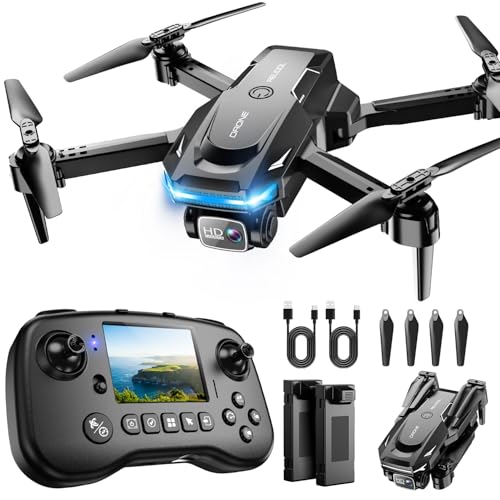
The RELIDOL PK01 drone integrates a built-in screen on the remote, letting flyers watch live HD footage and monitor flight stats without pairing a phone. This makes it ideal for beginners who want immediate, on-the-spot feedback. It uses brushless motors for durability and stability, and features like one-key takeoff/landing, headless mode, and 360° flips support confident learning and fun flying. An SD card is required to save imagery and video, which should be planned for when buying. Best for first-time pilots who prefer an all-in-one FPV experience and easy maneuverability.
Best for: Absolute beginners or casual flyers who want instant FPV visibility and simple controls.
Why selected: Combines a built-in screen with robust flight features in a foldable package, reducing setup friction.
Caution: Media storage requires an SD card not included in the package.
RC Drone With Camera, 4.92in Screen Controller

The APIZCUK drone pairs a large 4.92-inch screen on the controller with real-time FPV transmission. It emphasizes stability through optical flow positioning and a 6-axis gyroscope, making it well-suited for indoor flights and visual-first pilots who want clear live feedback. Dual cameras and EIS help stabilize footage, while gesture control adds a simple hands-free option for photos and videos. Best for: indoor enthusiasts who value an on-controller display and straightforward camera operation.
Best for: Indoor flyers and social content creators who want direct FPV on the controller without a separate device.
Why selected: Combines a large display with dual cameras and stabilization for consistent FPV footage.
Caution: Some advanced features rely on app control, which may require extra setup.
Drone With Camera for Adults, 2K HD FPV Drones

The Loiley model centers on portability and travel-friendly use with a 2K camera and a 90° remote-adjustable angle. It pairs altitude hold and optical flow positioning for steady flights, plus headless mode to simplify directional control. A compact foldable design and sub-250g weight suit travelers who want to avoid FAA registration in many contexts. Best for: Travelers and social media enthusiasts seeking a lightweight, easy-to-pack drone with reliable video.
Best for: Travel shooters who prioritize compact size and easy setup.
Why selected: Strong combination of foldability, 2K camera, and stable flight in a small form factor.
Caution: Some users may want higher resolution video for professional editing.
GPS Drone With EIS 4K Camera and 4.5 Inch Screen
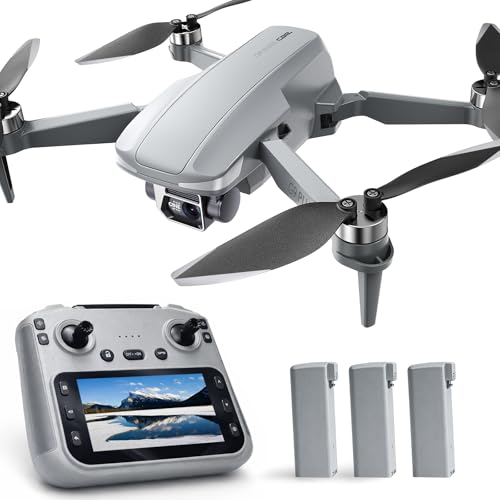
This CHUBORY drone emphasizes GPS-assisted, reliable outdoor flights with a built-in 4.5-inch HD display on the controller and a 4K camera with 90° tilt. It supports long-range transmission and auto-return features through GPS, making it suitable for beginners who want safety netting during outdoor shoots. The 4K camera offers elevated resolution for landscapes and larger prints. Best for: Outdoor creators who want GPS-based safety and a strong live FPV experience on the controller.
Best for: Outdoor enthusiasts seeking GPS stability and a higher-quality camera.
Why selected: Combines GPS flight safety, 4K imagery, and a dedicated built-in display for easy viewing.
Caution: Outdoor use relies on GPS signal; indoor use may need GPS mode turned off for hover stability.
GPS Drone With 1080P Camera, 4.5″ LCD Screen

The Sewsunny model offers an integrated 4.5-inch LCD remote for FPV viewing without pairing a phone. It supports up to 600 meters of UHD-like transmission and offers both a physical screen remote and a mobile app control option for flexible use. The 1080P camera with 90° tilt provides practical aerial photography, while GPS-assisted features like auto return and Follow Me add safety plus creative modes. Best for: Beginners who prioritize a dedicated FPV screen and flexible control options.
Best for: New pilots who want a straightforward FPV experience with GPS safeguards.
Why selected: Reliable dual-control options and a responsive 1080P camera for entry-level aerials.
Caution: The camera is 1080P, which may not satisfy users needing higher-resolution footage for big projects.
Buying Guide
What to consider when choosing an RC drone with a camera
- Display on controller: Do you prefer a built-in screen or do you plan to use a phone or tablet for FPV? Built-in screens simplify setup and reduce device management during flight.
- Flight stability: Look for features like GPS positioning, optical flow, altitude hold, and headless mode. These help beginners maintain stable flights and easier framing of shots.
- Camera capabilities: Resolution (1080p, 2K, 4K) and tilt range impact the quality of your aerial footage. A higher-resolution camera is beneficial for larger displays or print work.
- Safety features: Return-to-home, obstacle avoidance, and geofencing can prevent losses and collisions, especially for beginners flying outdoors.
- Battery life and charging: Consider flight time and whether the drone supports multiple batteries for longer shoots. Compact, foldable designs are ideal for travel.
- Portability: If travel is a priority, a lightweight, foldable drone under 250g often aligns with regulatory considerations in many regions.
- Storage options: Some controllers include SD card slots or support direct saving to the remote. Plan for media storage needs early.
How to choose by use case
- Indoor learning: Prioritize stability features like optical flow, 6-axis gyros, and an accessible display for real-time feedback.
- Travel vlogging: Emphasize compact design, 2K/4K cameras, and long battery life with easy sharing options.
- Beginner outdoor photography: Look for GPS return, Follow Me, Circle Fly modes, and a reliable HD camera for landscape shots.
- Content creators: Higher resolution (4K) and advanced gimbal or stabilization features enable cinematic footage and creative angles.
Frequently asked questions
- What is the advantage of a drone with a built-in screen? Answer: It provides immediate FPV viewing without needing a separate phone, reducing setup steps and keeping the focus on flying.
- Do drones under 250g require registration? Answer: In many regions, lighter drones avoid certain registration requirements, but rules vary by country—check local regulations before flying.
- Is a 4K camera necessary for beginners? Answer: Not essential for learning; 1080P or 2K can be sufficient for practice and basic footage, with 4K offering greater future-proofing.
- What is optical flow positioning? Answer: A sensor-based system that helps the drone hover steadily by analyzing ground features, improving indoor stability.
- Should I buy a drone with obstacle avoidance? Answer: Obstacle avoidance reduces collision risk, especially in confined spaces or complex outdoor environments, but it’s not a substitute for careful piloting.
- Which features matter most for beginners? Answer: Easy takeoff/landing, altitude hold, stable GPS/indoor positioning, and a clear FPV display are top priorities for new pilots.