For serious flight sim enthusiasts, a high-quality throttle quadrant that manages multiple engines and control surfaces can greatly enhance realism and efficiency. This guide spotlights five top options that balance build quality, programmability, and adaptability across various aircraft types. Each product includes practical mounting options, diverse control axes, and software support to tailor your cockpit setup. The selections cover established brands and feature-rich configurations suitable for both hobbyists and aspiring pilots.
| Product | Brand | Key Features |
|---|---|---|
| Logitech G Saitek PRO Flight Throttle Quadrant | Logitech G | 3 axis levers, 3 two-way rocker switches, adjustable mounting |
| CH Products Throttle Quadrant USB (300-133) | CH Products | Six axes, 12 buttons, large mounting base, Control Manager software |
| Logitech G PRO Flight Yoke System | Logitech G | Yoke, throttle quadrant, 75 programmable controls, 3-mode operation |
| Saitek Three Lever Pro Throttle Quadrant (PZ45) | Mad Catz | 3 axis levers, 3 two-way rocker switches, flexible mounting |
| Honeycomb Bravo Throttle Quadrant | Honeycomb Aeronautical | Autopilot, annunciator panel, gear and flaps levers, trim wheel |
Logitech G Saitek PRO Flight Throttle Quadrant Overview
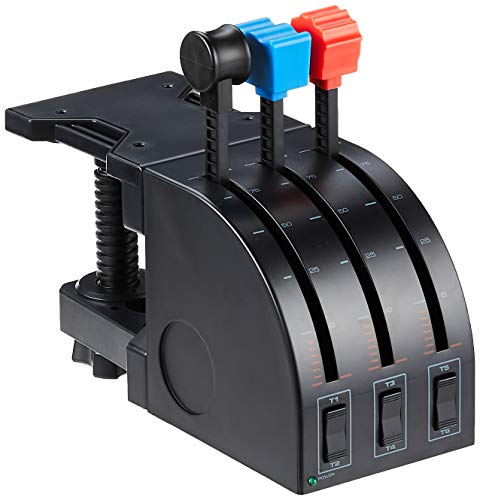
The PRO Flight Throttle Quadrant offers three axis levers for engine controls and three two-way rocker switches to supplement flight operations. Its versatile mounting lets you position the quadrant on top or in front of a desk to fit both pilot and co-pilot layouts. USB connectivity and a robust build support extended sim sessions, while the LCD display provides quick status feedback during simulations.
CH Products Throttle Quadrant USB (300-133) Overview

CH Products delivers six axes and 12 buttons for comprehensive engine management. The setup includes the X, Y, Z, R, U, and V axes, plus a broad swath of programmable functions via Control Manager software. It features a sturdy mounting base with adjustable clamps compatible with 3/4-inch to 2 1/4-inch desk thickness, ensuring a solid cockpit integration for multi-engine aircraft simulations.
Logitech G PRO Flight Yoke System Overview
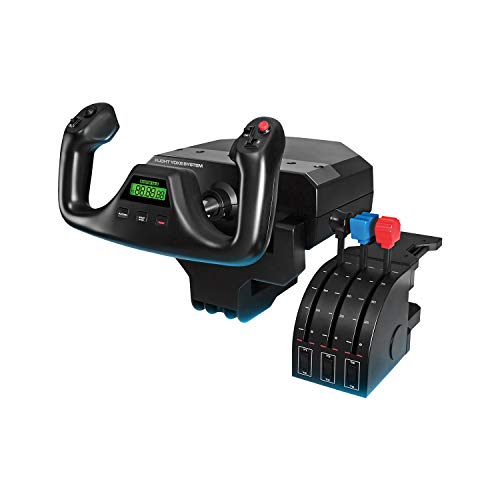
This integrated yoke and throttle system emphasizes realistic control with a robust steel shaft and responsive flight hardware. The package includes a complete throttle quadrant, a yoke, clamps, and required cables, delivering up to 54 programmable controls through a 3-position mode switch and multiple knobs. It’s well-suited for users building a full cockpit and seeking a comprehensive, configurable flight experience.
Saitek Three Lever Pro Throttle Quadrant (PZ45) Overview

The Three Lever Pro Throttle Quadrant extends your control surface with three axis levers and three two-way rocker switches. It can be mounted on top or in front of your desk to accommodate pilot or co-pilot preferences. This flexibility helps operators map engine power, prop pitch, and other essential flight controls with ease, maintaining a compact footprint for smaller sim setups.
Honeycomb Bravo Throttle Quadrant Overview

Honeycomb’s Bravo Throttle Quadrant offers a complete cockpit experience with an autopilot panel, annunciator panel, gear lever, flap lever, and a trim wheel. It supports configurable throttle setups across single-engine to four-engine aircraft, delivering precise control and a realistic flight sim environment. The device is designed for immersive training and long-duration sessions with a clean, professional look.
Buying Guide: Key Purchase Considerations
- Aircraft compatibility: Multi-engine sims benefit from quadrants that support several engine controls, axis permutations, and cockpit mappings. Verify the number of axes and programmable buttons each model provides.
- Mounting and footprint: Consider desk depth and mounting options. Some models offer top-mounted or front-facing placement to suit pilot and co-pilot arrangements.
- Software and programmability: Control Manager or equivalent software can unlock extensive customization. Check for profile sharing, calibration tools, and easy mapping of real-world engine procedures.
- Build quality and durability: Flight simulators demand sturdy construction and smooth analog levers. Steel shafts, quality detents, and stable bases reduce wear over time.
- Expansibility: If you anticipate growing your cockpit, choose a quadrant that works well with additional gear (yokes, rudder pedals, and panels) and supports updates or renewals without losing mappings.
- Realism vs. cost: Premium options deliver more authentic feedback and wider control sets, but entry-level models still provide functional multi-engine capabilities. Balance budget with desired fidelity.
- Brand ecosystem: Some brands pair neatly with their own yokes and panels, while others offer broad cross-compatibility. Consider your preferred ecosystem for a cohesive setup.
When selecting a multi-engine throttle quadrant, prioritize a balanced mix of axes, programmable controls, and adaptable mounting. This helps you map engine power, prop control, and flight surfaces to match real-world procedures, enhancing both training value and immersion in flight simulations.