Answering what to buy for accurate, eye-catching historical displays: these 3D models range from miniature infantry figures to iconic landmark puzzles and historic ships. This selection serves collectors, diorama builders, educators, and hobbyists who want ready-to-paint pieces or assembly kits. The top picks include historically themed infantry, iconic monuments, and famous vessels. Each entry notes best-for scenarios and a practical limitation to consider when planning displays or dioramas.
Summary of chosen products
- Kowaku 7 Pieces Historical Conflict II Infantryman Figures
- Statue of Liberty 3D Puzzle, 32-Piece NYC Landmark
- Metal Earth USS Constitution 3D Metal Model Kit
- Piececool Queen Anne’s Revenge Pirate Ship Model Kit
- B-29 Super Fortress Model Plane
Kowaku 7 Pieces Infantry Figures for Dioramas

Best for: diorama builders seeking a unified team of infantry figures for historical scenes. The set includes seven resin figures in a single-piece construction, ready for painting and display. The gray base finish helps with neutral mounting and stable placement. A potential limitation is the absence of separate bases, which may require careful positioning during painting and display.
Why it’s selected: the figures offer cohesive poses suitable for recreating historical battles or display scenarios, and the unpainted resin surface is ideal for custom painting to match specific eras or uniforms. The compact 1/72 scale is widely compatible with other model figures and diorama bases.
Best use tips: pair with a diorama base or terrain mat to create a field or battlefield vignette. Use enamel or acrylic paints compatible with resin for long-lasting color.
Caution: resin figures can be fragile during handling; use soft brushes when painting to minimize breakage.
Statue of Liberty 3D Puzzle
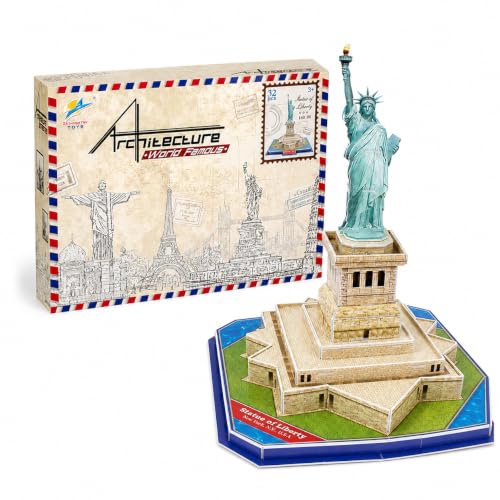
Best for: educational desks and display shelves where a scalable landmark model adds a New York City theme. The 32-piece puzzle builds a layered base with the statue, pedestal, fort, island, and water elements. The finished model fits compact displays without dominating space.
Why it’s selected: this model transforms from flat puzzle pieces into a recognizable landmark, offering an engaging hands-on building experience and a visually impactful centerpiece for a patriotic or history-focused display.
Best use tips: place on a stable surface and use a clear sealant to preserve the layers and colors after completion.
Caution: assembly requires patience; small pieces may be challenging for younger or less dexterous builders.
Metal Earth USS Constitution 3D Metal Model Kit

Best for: hobbyists who enjoy metal puzzles and precise assembly without glue or solder. The kit uses metal sheets and tweezers for bending, with a 1:528 scale and a compact final size. It’s a tighter build requiring careful handling and patience.
Why it’s selected: the kit provides a distinctive metal construction approach that emphasizes precision and fine detail, suitable for display cabinets or educational demonstrations of ship design from the era.
Best use tips: organize parts on a flat mat, use steady hands, and follow the instruction sheet step-by-step to reduce misalignment.
Caution: no glue is required, but improper bending can lead to weak joints; take your time with each connection.
Piececool Knight of Firmament Mecha Model

Best for: adults seeking a challenging metal puzzle that doubles as a decorative piece. The kit’s 134 pieces form a mechanical figure that serves as striking home decor or a studio display piece.
Why it’s selected: its intricate engineering and modern aesthetic provide a unique contrast to traditional historical figures, appealing to collectors who want diverse display elements and stress-relief crafting.
Best use tips: plan assembly sessions, use a light magnifier for small connections, and keep tweezers handy for precise bends.
Caution: complexity level may extend assembly time beyond typical hobby sessions; be prepared for a longer build process.
B-29 Super Fortress Model Plane

Best for: aviation historians and model builders who want a World War II aircraft with sturdy 3D printed construction. The kit emphasizes durability and display value with a stand and a historical aviation theme.
Why it’s selected: the B-29 model represents a significant air-era artifact, useful for classroom displays, museum-style dioramas, or personal collections of wartime aircraft.
Best use tips: assemble on a clean surface, use fine brushes for detailing, and consider a light protective coating to prevent wear on the surface finish.
Caution: 3D printed parts may require careful removal of burrs; sand lightly before painting to achieve smoother surfaces.
Buying Guide: Key Purchase Considerations for Historical Figures 3D Models
- Purpose and display space: Decide if you need figures for dioramas, a desk display, or a classroom demonstration. Measure the height and footprint of each model to ensure a cohesive scene.
- Material and finish: Resin figures are paint-friendly but can be fragile. Metal kits offer a different tactile feel and durability but may require more careful handling during assembly.
- Skill level and time: Some kits are ready-to-paint or pre-assembled, while others demand hours of assembly. Match the project time to your schedule.
- Detail and scale: Consider how the scale (like 1/72 or 1:528 for ships) aligns with other pieces in your collection for consistent visuals.
- Maintenance and storage: Plan for display cases or shelves that protect small parts and prevent dust buildup on intricate models.
- Educational value: For classroom use, choose models with recognizable landmarks or ships to support historical context and storytelling.
FAQ: Quick Answers For Buyers
What is the best starter kit for historical 3D models?
Amiable options include unpainted resin infantry figures for painting practice or a simple 32-piece landmark puzzle for an introductory build.
Are metal 3D puzzles harder than resin kits?
Usually yes. Metal kits require cutting, bending, and alignment without glue, which can be more challenging but offers a different assembly experience.
Can these models be used for educational dioramas?
Yes. Many pieces depict recognizable historical subjects, making them suitable for classroom displays and study aids.
Do these kits require special tools?
Most metal kits need tweezers and basic bending tools; resin kits typically need brushes and paints. Check the product’s included items and recommendations.
How should I finish unpainted resin figures?
Prime with a suitable primer, then apply acrylic paints in layers. seal with a matte protective topcoat to prevent chipping and to reduce shine.