Discover practical, engaging instruments and kits that help kids in grades K-6 explore rhythm, melody, and creativity. This guide highlights five beginner-friendly options designed for classroom-friendly learning and family practice alike. Each pick supports hands-on learning, safe materials, and clear entry points for new players.
Product Spotlight — A quick glance at the five featured picks to help you compare at a glance:
| Product | Brand | Key Benefit | Notes |
|---|---|---|---|
| Build Your Own Musical Instrument Kit | SCAEMO | DIY learning with touch-play notes | Portable, battery-powered, beginner-friendly |
| Cecilio Closed Hole C Flute | Cecilio | Beginner flute with 16 keys | Includes case, pads, cleaning gear |
| Mr.Power Soprano Recorder | Mr.Power | Easy beginner recorder with 8 holes | Good for early wind training |
| Kids Musical Instruments Set | Taimasi | 33-piece multi-instrument set | Great for rhythm exploration |
| LOOIKOOS Wooden Music Set | LOOIKOOS | Natural wooden instruments with storage | Montessori-friendly |
SCAEMO Build Your Own Instrument Kit

The SCAEMO kit invites students to assemble a functioning electronic instrument in about 10 minutes. It uses a touch-sensitive circuit board, a wooden shell, a speaker, and a battery box—no soldering or glue required. Designed for both beginners and those exploring STEM concepts, the kit supports hands-on learning, with eight touchpads producing distinct musical notes. Features include a vibrato switch and a volume control for expressive play. Its compact size fits easily into a classroom bag or a backpack, enabling practice anywhere a student travels.
Ideal for classrooms focused on STEAM integration, this kit encourages experimentation with sound, circuits, and user interaction. It serves as a bridge between music education and basic electronics, helping students understand cause-and-effect in a tangible way. While compact, it provides meaningful sonic feedback, making it suitable for short lessons or individual exploration during free time.
Cecilio Closed Hole C Flute

This nickel/silver-plated closed-hole C flute is positioned as a solid start for wind instrument learners. The set includes a protective case, joint grease, a cleaning cloth and rod, and beginner-friendly pads. With 16 keys and an offset G key plus split E key, students get a complete, portable option for practice both at home and in school ensembles. The instrument’s finish and design emphasize durability and ease of maintenance for daily use by beginners.
Suitable for school music programs emphasizing consistent technique, this flute supports basic embouchure development, finger placement, and breath control. While designed for beginners, it also offers room to grow as a student advances, making it a reasonable long-term starter. Students should expect regular maintenance like cleaning and pad care to maintain tone quality over time.
Mr.Power Soprano Recorder German Style

The Mr.Power soprano recorder provides an approachable wind instrument option for early music study. Its 8-hole design and German-style construction produce mellow tones suitable for Renaissance and modern repertoire. Three-piece construction aids cleaning and maintenance, a practical consideration for classroom environments where instrument longevity matters. The blue variant adds a visually engaging option for younger students who are excited by color choices.
For music teachers seeking a simple wind instrument to teach breath support, fingering, and musical phrasing, this recorder offers a straightforward path. It pairs well with basic music literacy activities and ensemble practice, though students should be guided to avoid overstress on beginners’ fingertips. Regular practice with proper technique can help mitigate common beginner issues like pitch consistency and air flow control.
Taimasi 33-Piece Wooden Instrument Set

This multi-instrument set introduces children to a broad sonic palette, including shaking, tapping, beating, and blowing instruments. The 33 pieces cover tambourine, xylophone elements, and other percussion-family tools, making it ideal for rhythm-building activities, classrooms, and group music time. The kit emphasizes non-toxic materials and lead-free paint, aligning with safety standards for young users. It is well-suited for exploratory play, classroom stations, or as a birthday gift that kickstarts a child’s musical curiosity.
Educators can leverage this set to illustrate basic musical concepts like tempo, beat, and coordination. The variety encourages children to experiment with different sounds and textures, supporting auditory discrimination and collaborative play. For parents, the kit offers an approachable way to practice listening skills and rhythm at home, with minimal setup required and straightforward organization.
LOOIKOOS Wooden Music Set
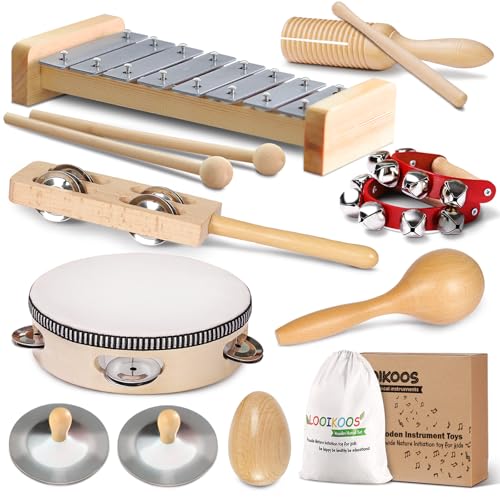
The LOOIKOOS wooden music set emphasizes natural materials and Montessori-style learning. This collection includes shaking, tapping, and beating instruments, all crafted from wood with a storage bag for organization. Its emphasis on eco-friendly design and simple, real-wood textures appeals to families and classrooms seeking sustainable choices. The storage bag helps keep tools accessible and reduces clutter during practice sessions.
From a pedagogical perspective, wooden instruments support tactile learning and tactile feedback that can help children connect sound with physical action. The set is well-suited for early music education, where teachers can guide students through basic rhythms, tempo changes, and ensemble listening. The natural tone of wooden instruments often encourages longer engagement and a focus on fundamentals before moving to electronic or more complex instruments.
Buying Guide: Key Purchase Considerations
When choosing grade-school instruments, consider the following perspectives to balance learning outcomes, safety, and practicality:
- Curriculum fit: Align instrument types with your teaching goals—wind, percussion, or beginner electronics—to support a cohesive music unit or program.
- Age appropriateness: Match the instrument’s size, complexity, and maintenance needs to the student cohort, ensuring it’s accessible for the majority of learners.
- Durability and safety: Look for non-toxic materials, sturdy cases, and simple maintenance requirements suitable for classroom use and home practice.
- Maintenance burden: Some sets require regular cleaning, pad care, or battery changes. Plan for routine care to preserve instrument longevity.
- Storage and transportation: Choose sets with compact storage options or bags to minimize clutter and make it easy to move between classrooms or homes.
- Learning path flexibility: Select instruments that offer both quick wins for motivation and potential for progression as skills develop.
- Budget and value: Compare upfront costs with long-term utility, including whether the set supports multiple students and evolves with advancing skills.
Consider a balanced mix, such as a core wind instrument (flute or recorder), a percussion array (sampled from a multi-instrument kit), and a small keyboard-friendly or DIY option for STEM connections. This approach helps accommodate diverse learning styles and keeps students engaged across a semester or school year.