If you’re new to RC aviation, the right beginner kit makes learning to fly easier and more enjoyable. This guide highlights beginner-friendly RC plane kits that emphasize stability, simple controls, and durable design. Ideal buyers include kids starting out, hobbyists exploring flight basics, and parents seeking forgiving, easy-to-fly options. Below you’ll find five top picks with clear, actionable details to help you compare at-a-glance.
| Product | Best For | Why It Stands Out |
|---|---|---|
| RGIMF RC Paper Airplane Kit | Complete beginners | Gyro stabilizer and dual propellers support stable flights; easy remote control setup |
| Harrisville Designs RC Airplane | First-time flyers | Lightweight EPP build; 2.4 GHz 2-channel for straightforward control |
| RC Paper Airplane Kit (Generic) | DIY enthusiasts | Out-of-box DIY feel with gyro stabilizer for steadier flight |
| HAWK’S WORK 2 CH RC Glider | Kids and beginners | Self-stabilization and simple 4-direction control |
| HAWK’S WORK 3CH P-51D Mustang | Progressive beginners | Three-channel options with gyro stabilization for varied flight modes |
RGIMF RC Paper Airplane Kit

The RGIMF kit uses an easy-to-operate remote control system designed for model enthusiasts, pilots, and DIY fans. It features gyro stabilization and dual rotors to promote stable, balanced flight. This kit is best for beginners who want quick, forgiving flights and simple setup. A limitation to note is that paper-airplane materials can be sensitive to wind and outdoor conditions, so indoor use is often recommended.
Harrisville Designs RC Airplane

This lightweight 2-channel RC airplane uses 2.4 GHz control and lightweight EPP material, making it easy to handle and resistant to minor bumps. With a flight time around 10 minutes per charge, it’s well-suited for new pilots who want short, manageable sessions to practice directional control and basic maneuvers. Best for learners who prefer a simple, forgiving platform and quick reloads between flights.
RC Paper Airplane Kit (DIY Drones)
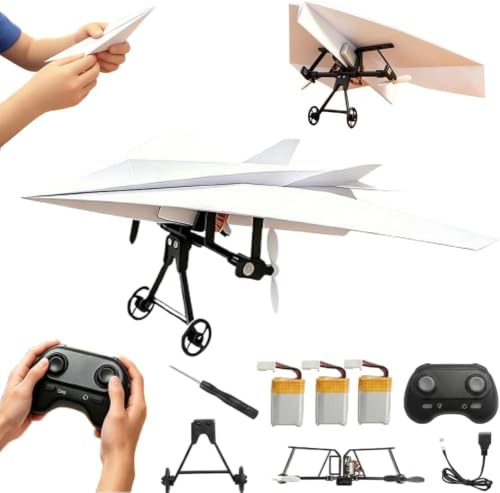
This DIY drone-style paper airplane kit emphasizes beginner-friendly operation with a gyro stabilizer and dual propellers for smoother, steadier flight. It’s ideal for hobbyists seeking a hands-on build experience combined with reliable stability. A potential limitation is that the kit requires basic assembly; new users should expect a short learning curve during setup.
HAWK’S WORK 2 CH RC Glider

This 2-channel RC glider is built with a lightweight foam structure and a built-in self-stabilization system. It’s well-suited for kids and beginners who want a forgiving, easy-to-fly experience. The 2.4 GHz radio supports multiple planes without interference. Consider avoiding this if you need longer flight durations per charge, as endurance is typically limited by battery capacity.
HAWK’S WORK 3CH P-51D Mustang

This 3-channel Mustang RC plane adds stability with a 6-axis gyro and offers two take-off modes for different flight experiences. It comes with two rechargeable batteries, enabling longer flight sessions and more practice in speed control and maneuvering. Choose this if you want a progression path from beginner to more capable flight modes.
Buying Guide: Key Purchase Considerations
- Stability vs. realism: If you want forgiving flights, look for gyro stabilization and a stable dual-prop design. For more realistic flight dynamics as you improve, seek 3-channel models with advanced stabilization.
- Control system: Start with 2.4 GHz radios for reliable, interference-free control. If you plan to fly multiple planes, ensure the controller supports multiple aircraft without cross-talk.
- Materials and durability: Foam and EPP materials absorb impacts better for beginners. Lightweight builds reduce crash damage and console repairs.
- Flight duration: Short flights are common with beginner kits. If longer practice sessions are a goal, check battery life and the possibility of carrying spare batteries.
- Assembly effort: DIY kits provide hands-on learning but require more time. Ready-to-fly designs reduce setup time and speed up the learning curve.
- Indoor vs. outdoor use: Paper airplane and lightweight foam kits often perform best indoors or in calm outdoor spaces. Outdoor wind can impact stability significantly.
Frequently Asked Questions
- What is the best beginner RC plane kit for absolute first-timers? – A kit with gyro stabilization, multiple take-off modes, and durable foam or EPP construction is ideal for first flights and quick skill building.
- Do beginner kits require prior piloting experience? – Most do not; they’re designed to be flown with minimal prior experience, focusing on stability and simple controls.
- What should I consider for indoor use? – Look for lightweight, compact models with gentle wing geometry and gyro stabilization to minimize drift in limited spaces.
- Are DIY kits worth it for beginners? – Yes, they offer hands-on learning and can improve understanding of flight mechanics, provided you’re patient with assembly.
- How long do batteries typically last on beginner planes? – Flight times vary, but many beginner kits offer 8–20 minutes per charge, with batteries designed for quick swapping.
- Is it better to start with a 2-channel or 3-channel plane? – Start with 2-channel for basic up/down and left/right control; move to 3-channel when you want to practice more nuanced maneuvers and speeds.