Answering the needs of learners, makers, and developers, this guide highlights five 3D printed or 3D-printed-part robot arm kits that are accessible, well-documented, and suitable for hands-on AI and robotics projects. Each product is chosen for clear assembly paths, open-source or transferable software support, and practical use for education or hobbyist prototyping. The top picks are best for students, hobbyists, and researchers exploring imitation learning, computer vision, and autonomous manipulation.
Summary at-a-glance for quick comparison:
| Product | Best For | Open-Source/Extras |
|---|---|---|
| SO-ARM101 Low-Cost AI Arm 3D Printed Skeleton | Budget-limited learners, beginners | Open-source, LeRobot integration, extensive learning resources |
| AI Robotic Arm Kit Hiwonder SO-ARM101 (Advanced Kit) | Developers exploring AI research | End-to-end imitation learning, dual-camera vision |
| UNCLE BRICK Technical Tracked Arm | STE M enthusiasts, kids 8–14 | Remote control, large build, gears included |
| 3D Printed Robot T Action Figure Set | Desktop decor with mechanical flair | Fully assembled, 20+ articulations |
| AI Robotic Arm Kit Hiwonder SO-ARM101 (Standard Kit) | Hands-on AI prototyping | Imitation learning, bus servos, dual cameras |
SO-ARM101 Low-Cost AI Arm 3D Printed Skeleton

The SO-ARM101 skeleton emphasizes low-cost, open-source robotics. It is designed for integration with LeRobot, which supports PyTorch-based models, datasets, and tools for reinforcement and imitation learning in real-world robotics. This kit is best for beginners and students who want an affordable entry point into open-source robotics and AI-enabled control. A key benefit is access to assembly and calibration guides, plus tutorials for data collection and deployment.
Best for: learners starting with open-source robotics, those on a tight budget, and educators piloting classroom projects. Limitation: may require additional components or boards to complete full functionality depending on the build path.
AI Robotic Arm Kit Hiwonder SO-ARM101 Embodied Imitation Learning Open Source 6-Axis Robot Arm (Advanced Kit)

This advanced kit pairs a 6-axis robot arm with 12 high-torque bus servos and magnetic feedback, delivering smooth motion suitable for imitation learning. The kit includes dual-camera vision (gripper-mounted and external), aiding precise manipulation and environment awareness. It aligns with Lerobot open-source workflows, offering templates, pre-trained models, and example projects for AI researchers and developers. Best for: developers pursuing end-to-end AI experiments and researchers testing vision-guided manipulation. Caution: higher component demands may increase setup complexity and power needs.
UNCLE BRICK Technical Tracked Robotic Arm Kit

UNCLE BRICK’s tracked robotic arm is a STEM-focused building kit with 1468 pieces, four M-type motors, and a remote control. It supports 90-degree arm swing and over 180 degrees gripper travel. This kit is ideal for hands-on learning about robotics, control systems, and gear mechanisms in a classroom or home workshop. Best for: older kids and beginners who want a robust, mechanical building experience and remote operation. Limitation: heavy and possibly more challenging to store or transport than smaller kits.
3D Printed Robot T Action Figure Set, 2 Pieces

This 3D-printed action figure set blends decorative appeal with mechanical form. With multiple articulation points and a ready-to-pose design, these figures suit desk decor for sci-fi fans and creators who enjoy poseable, display-worthy robots. Best for: desktop aesthetics and light mechanical display. Caution: not a functional manipulation arm for handling real-world objects beyond display purposes.
AI Robotic Arm Kit Hiwonder SO-ARM101 Standard Kit
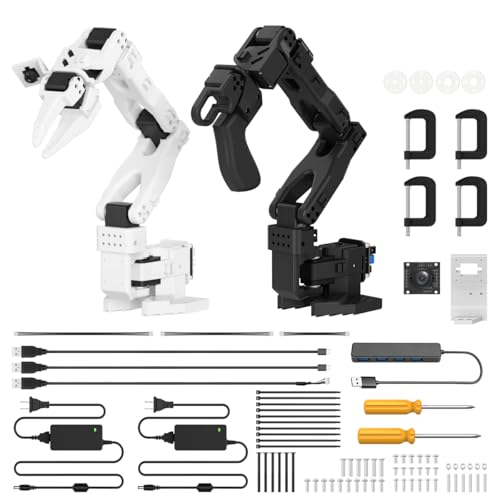
The standard SO-ARM101 kit provides end-to-end imitation learning support with a dual-camera system and high-torque bus servos. It is well-suited for prototyping AI-enabled manipulation workflows and learning how to train models for robotic control. Best for: researchers and students who want a complete, scalable platform with documented AI workflows. Limitation: fewer assembly options compared to the advanced kit, which could limit customization at times.
Buying Guide
What should I consider before choosing a 3D printed robot arm?
Purpose: Define whether you want learning, prototyping, or display. kits with open-source software and tutorials help reduce setup time for beginners, while advanced boards and camera systems suit researchers.
Open-source friends or software ecosystems
Open-source frameworks like Lerobot or similar platforms enable access to pre-trained models, templates, and data. Consider whether you need imitation learning, reinforcement learning, or simple manipulation experiments.
Mechanical complexity and axis count
Six-axis arms offer greater reach and versatility, but may cost more and require more tuning. Fewer axes tend to be easier for beginners and educational settings.
Vision and sensing capabilities
Dual-camera setups improve environmental awareness and manipulation accuracy. They matter for tasks that require precise grasping or pose estimation in real-world contexts.
Build materials and hardware quality
Ensure a robust set of servos or motors, reliable joints, and a sturdy structure. Heavy or high-torque systems demand proper power supplies and heat management.
Maintenance, spare parts, and community support
A kit with plentiful spare parts and a strong user community helps with troubleshooting and long-term projects. Check availability of replacement gears, belts, and mounts.
FAQ
- What is a 3D printed robot arm good for? It is useful for education, prototyping, and AI research workflows, including perception, control, and manipulation experiments.
- Do these kits require advanced skills? Some kits are beginner-friendly with tutorials, while advanced kits suit researchers and developers with AI workflows.
- Can I integrate these arms with open-source AI frameworks? Yes, several kits support Lerobot or similar open-source platforms for imitation learning and model deployment.
- Is dual-camera vision important? Dual-camera setups aid environmental awareness and accuracy in manipulation tasks, especially for learning-based approaches.
- Are these arms suitable for classrooms? Many kits are designed for education, with clear assembly guides and scalable projects for students aged 8 and up, depending on the build complexity.
- What maintenance should I expect? Regular calibration, lubrication of joints, and occasional replacement of servos or gears can help maintain performance in longer-term projects.