Exploring the night sky with a large-aperture reflector telescope opens up deep-sky objects, planets, and the Moon in stunning detail. While some models are designed for advanced users, several 150mm–130mm reflectors offer beginner-friendly setups without sacrificing performance. This guide highlights five capable options that balance light gathering, stability, and ease of use. Each selection includes practical features like equatorial mounts, smartphone adapters, and carrying bags to support family-friendly stargazing and serious observing alike.
| Product | Brand | Aperture / Focal Length | Key Features |
|---|---|---|---|
| MEEZAA Telescope, 150EQ Newtonian Reflector | MEEZAA | 150mm / 650mm | Equatorial mount, two eyepieces, Barlow, moon filter, phone adapter |
| Telescope 130EQ Newtonian Reflector | SOLOMARK | 130mm / — | 1.5x Barlow, smartphone adapter, 13% Moon filter |
| Telescope 150EQ Astronomical Professional | Dianfan | 150mm / 650mm | Two eyepieces, 2x Barlow, easy EQ mount, terrestrial viewing |
| UncleHu 150EQ Newtonian Reflector | UncleHu | 150mm / 650mm | Stainless tripod, counterweight, EQ mount, moon filter |
| Celestron StarSense Explorer DX 130AZ | Celestron | 130mm / — | Smartphone dock, StarSense app, automated object suggestions |
MEEZAA Telescope, 150EQ Newtonian Reflector
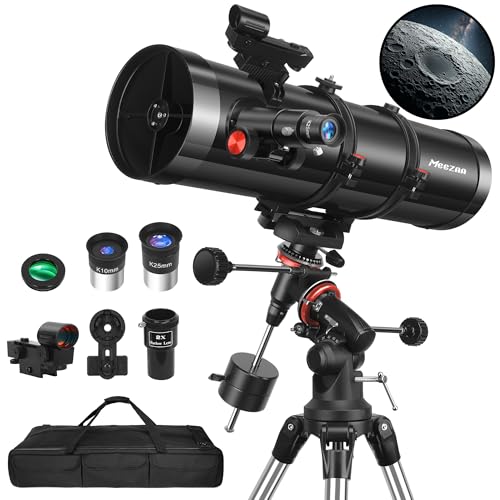
The MEEZAA 150EQ combines a 150mm aperture with a 650mm focal length, yielding solid light gathering for lunar detail, planets, and faint deep-sky objects. Its two eyepieces (25mm and 10mm) plus a 2x Barlow provide magnifications from 26x to 130x. A red dot finderscope helps with quick targeting, and the included moon filter reduces glare for comfortable lunar viewing. The upgraded German Equatorial Mount delivers smooth, precise manual tracking, ideal for beginners learning tracking basics while still satisfying more experienced observers.
Telescope 130EQ Newtonian Reflector

With a 130mm aperture, the SOLOMARK 130EQ emphasizes bright, detailed views of deep-space targets. Its fully coated glass optics offer improved clarity, while a sturdy carbon-fiber-inspired housing supports stable viewing. The German Equatorial Mount includes a dial and fine-turned control cables for precise positioning and smooth manual tracking. The package also highlights a 1.5x Barlow lens and a smartphone adapter, enabling terrestrial observation and quick astrophotography experiments for beginners and enthusiasts alike.
Telescope 150EQ Astronomical Professional
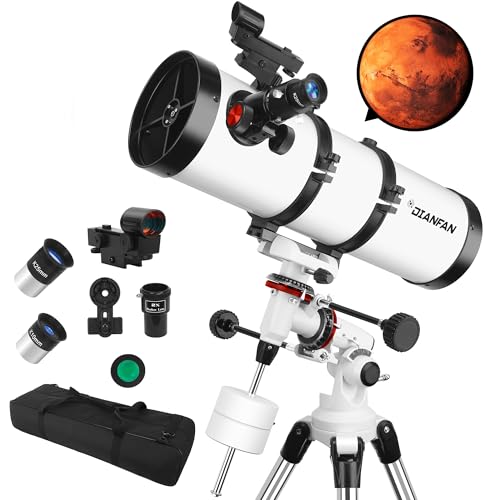
The Dianfan 150EQ is designed for serious beginners and developing observers, offering a 150mm aperture and 650mm focal length for bright, crisp images. It includes two eyepieces plus a 2x Barlow lens to reach up to 130x magnification. Setup is user-friendly with a pre-assembled equatorial mount, enabling smoother tracking as observers learn to follow lunar features and planetary detail. The scope also supports terrestrial viewing and comes with a carry bag and tripod for easy transport.
UncleHu 150EQ Newtonian Reflector

The UncleHu 150EQ combines a 150mm aperture with a sturdy stainless steel tripod and an EQ mount for accurate tracking. The setup emphasizes stability, with a counterweight to balance the optical tube and reduce vibrations. A Moon filter is included to reduce glare on close lunar views, while the dual slow-motion control cables enable precise adjustments for keeping objects centered as the sky rotates. This model is suitable for families and budding astronomers seeking dependable performance at a reasonable price.
Celestron StarSense Explorer DX 130AZ
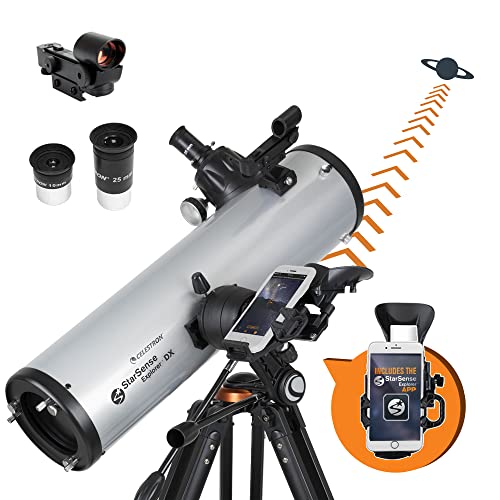
The Celestron StarSense Explorer DX 130AZ uses smartphone-based sky recognition to identify targets. Users dock their phone in the app, which analyzes star patterns to pinpoint telescope positioning and generate a curated list of objects to observe based on time and location. This techno-assisted approach is ideal for beginners who want guided learning while still enjoying quick accessibility to planets, nebulae, and star clusters from urban and dark-sky sites alike. The 130mm aperture provides solid light gathering and a portable form factor for easy transport.
Buying Guide
- Aperture matters: Larger apertures gather more light, enabling crisper planetary detail and fainter deep-sky objects. The 130–150mm range is a practical balance for beginners and hobbyists.
- Mount type affects usability: German Equatorial Mounts offer smooth tracking for manual observing, while computerized or app-assisted mounts help beginners find objects quickly.
- Ease of setup and transport: Look for pre-assembled or easy-assembly designs, plus included tripods and carrying bags for family use or field observing.
- User aids: Moon filters, Barlow lenses, and smartphone adapters expand viewing options and enable basic astrophotography or time-lapse experiments.
- Software and guidance: Apps that assist with target selection and sky navigation can reduce the learning curve for new stargazers.
- Durability and stability: A solid tripod and balanced mounts minimize vibration and improve image stability during high magnification.
- Terrestrial viewing: Many 150mm models also suit daytime observing, offering versatile family-friendly use beyond astronomy.
- Budget considerations: Accessories (filters, extra eyepieces, adapters) can significantly affect total cost; prioritize essential components first.
- Future upgrade paths: If you anticipate advancing your observing skills, choose a model with a robust mount and compatibility with additional eyepieces or upgrade options.
- Warranty and support: Brand-backed warranties and reliable customer support help with long-term satisfaction and maintenance.