Discover top 10 inch Newtonian telescopes that balance large aperture with user-friendly design. This guide highlights five options, including the latest StarSense-enabled models and classic Dobsonians, to help you compare optical performance, ease of use, and accessory versatility.
| Product | Brand | Aperture | Type | Notes |
|---|---|---|---|---|
| Celestron StarSense Explorer 10-inch | Celestron | 254 mm | Dobsonian | Smartphone-driven sky tour, StarSense tech |
| Sky-Watcher Quattro 250P Imaging Newtonian | Sky-Watcher | 250 mm | Reflector | Fast f/4 optics, imaging capable |
| Sky Watcher Classic 250 Dobsonian 10-inch | Sky-Watcher | 254 mm | Dobsonian | Solid-tube, simple, beginner-friendly |
| Celestron NexStar 130SLT | Celestron | 130 mm | Newtonian, computerized | SkyAlign, portable yet smaller aperture |
| Celestron StarSense Explorer DX 130AZ | Celestron | 130 mm | Newtonian, app-enabled | Smartphone-guided sky tour |
The five selections below span true 10-inch-class Newtonians and closely related alternatives, offering a mix of Dobsonian-style ease and computerized guidance for modern stargazing. Each entry includes a brief overview of its strengths and key features drawn from the product listings.
Celestron StarSense Explorer 10-Inch App-Enabled Telescope
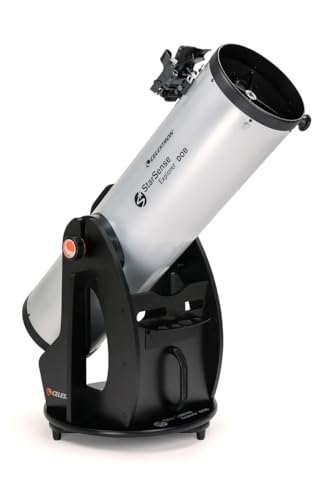
The Celestron StarSense Explorer 10-inch combines a large 254 mm aperture with StarSense technology and smartphone-based sky navigation. Users dock a smartphone into the telescope, open the StarSense Explorer app, and follow on-screen arrows to locate stars, planets, nebulae, and other deep-sky objects. The patented sky recognition analyzes star patterns to determine the telescope’s position, enabling a guided touring experience. The app also curates tonight’s top targets based on time and location, helping observers identify galaxies, nebulae, and star clusters from accessible viewing sites and dark skies alike.
- Smartphone-powered sky tour with no prior experience required
- Patented StarSense technology for precise navigation
- Curated target list tailored to time and location
Sky-Watcher Quattro 250P Imaging Newtonian

The Quattro 250P Imaging Newtonian offers a bright f/4 optical system with a 250 mm aperture for enhanced detail and fast exposure opportunities. It includes a 2-inch dual-speed Crayford-style focuser for precise focusing, an oversized secondary mirror that supports both APS-C and full-frame sensors, and a robust platform for astrophotography experimentation. This design emphasizes imaging versatility while preserving the range needed for deep-sky objects and planetary detail.
- Fast f/4 optics for bright, quick captures
- 2-inch dual-speed Crayford focuser for smooth focusing
- Oversized secondary mirror minimizes vignetting for larger sensors
Sky Watcher Sky-Watcher Classic 250 Dobsonian 10-Inch

The Classic 250 Dobsonian delivers a solid-tube, simple, traditional Dobsonian design with a 10-inch aperture for bright views across planets and deep-sky objects. Proprietary tension control handles enable accurate movement without perfect balance, while the fully multi-coated mirrors maximize light throughput. This straightforward setup emphasizes ease of use and dependable performance for beginners exploring a wide swath of the night sky.
- Large aperture at a cost-effective price
- Proprietary tension control handles for smooth motion
- Fully multi-coated mirrors for bright, sharp images
Celestron NexStar 130SLT Computerized Telescope

The NexStar 130SLT pairs a 130 mm Newtonian reflector with computerized object locating and a built-in database of thousands of targets. Its SkyAlign technology helps align the telescope quickly, enabling accurate tracking and a compact, portable footprint suitable for backyard use or trips to dark-sky sites. While aperture is smaller than 10 inches, its computer-guided usability makes it a strong option for learners who want automated object finding.
- Computerized star locating with thousands of objects
- Compact and portable for flexible observing
- Newtonian design with reliable tracking
Celestron StarSense Explorer DX 130AZ
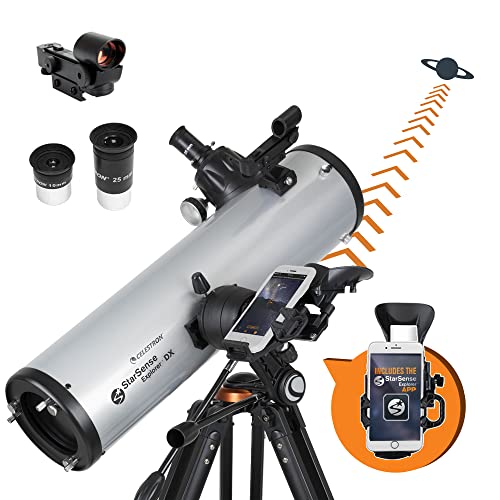
This StarSense Explorer DX 130AZ provides app-guided sky exploration with a 130 mm Newtonian reflector and a smartphone dock. StarSense technology analyzes star patterns to determine the telescope’s position, delivering curated targets for viewing from city locations and darker skies. It is a practical bridge between entry-level astronomy and more advanced observing with digital guidance.
- Smartphone-powered sky tour with autopilot-like guidance
- Patented sky recognition for precise orientation
- Curated targets tailored to observing conditions
Buying Guide: Key Considerations for 10-Inch Newtonian Purchases
- Aperture and practicality: A 10-inch (254 mm) aperture delivers brighter views and deeper-sky detail, but larger tubes are heavier and less portable. Consider your viewing location, ability to transport, and whether you want portable setup for travel or backyard use.
- Dobsonian vs. equatorial mounts: Dobsonians offer simple, intuitive tracking and wide-field views, ideal for beginners. Equatorial mounts provide smooth manual tracking and are better for astrophotography or longer observation sessions but require more setup and learning.
- Electronic assistance: Models with StarSense or other app-based sky mapping reduce the learning curve for locating objects. If you prefer a hands-on experience, a traditional manual scope may be more rewarding.
- Imaging potential: If you plan astrophotography, seek optics with robust imaging capabilities (e.g., larger aperture, compatible focusers, and suitable mount stability). Some 10-inch systems are optimized for imaging, while others excel for visual viewing.
- Portability and assembly: Larger apertures bring heavier components. Check weight, balance, and ease of assembly, especially if you need to carry the telescope outdoors or into storage spaces.
- Optical quality and coatings: Fully multi-coated mirrors and high-contrast optical coatings improve brightness and resolution. Check reviews for collimation stability and image sharpness at high magnification.
- Accessories and upgrades: Consider included accessories (finders, eyepieces, Barlow lenses, moon filters) and the potential for future upgrades such as better focusers or motor-driven tracking.
- Budget and long-term use: While a 10-inch scope represents a significant investment, its versatility for both planetary and deep-sky observing can justify the cost for serious beginners and hobbyists.